An integration (connector)
Teach Nik a product with an HTTP API: write its connector file, install it, make an instance, test each command, bring its alerts in as incidents and keep them in step.
The product. Example Alerts, an imaginary alerting service with a REST API at https://api.example.com/v1, signed in with a bearer token. It has alerts (read, list, change, comment), cases (opened once per idempotency key) and an IP reputation look-up. The finished file is at the end of the page; every piece below is part of it.
You need
The Connectors role (or Admin) to add the file and make instances. Playbooks or Analyst to use its commands.
A connector is data, not code: YAML checked against a fixed format, whose templates are the expression language. Every key is in Connector and pack format.
1. Who it is
# Example Alerts: alerts of an imaginary product, through its REST API at api.example.com.
# Signs in with a bearer token. Brings alerts in as incidents and keeps them in step both ways.
name: Example Alerts
id: example-alerts
version: 1
description: Alerts of Example Alerts as incidents, kept in step both ways; an IP reputation look-up.
api_version: "Example Alerts API v1"
verified: false
idis what playbooks call: commands becomeexample-alerts.get-alerton the canvas and!example-alerts-get-alertin the War Room. Never change it once used.versionis raised at each change: an installed connector is replaced only by a higher one.verified: falseuntil you have run each command against the real product.
2. What an instance asks for
configuration:
  - name: url
    label: Address
    type: url
    required: true
    default: https://api.example.com
    help: "The address of the API, https://api.example.com"
  - name: credentials
    type: bearer

base_url: "{{ config.url }}/v1"
headers:
  Accept: application/json

test:
  request: { method: GET, path: /me }
  expect: { status: 200 }
- Each entry becomes a field of the instance's Connection tab.
config.urlreads it. type: bearerasks for a token and sendsAuthorization: Bearer …with every request. Other kinds:basic,header,query,oauth2_client,session(the list).- Every request goes to the host of
base_url, and nowhere else (more hosts only throughmore_hosts). testis what Test sends: something that needs a good token and changes nothing.
3. Commands that read
commands:
  - name: get-alert
    description: Read an alert by its id.
    arguments:
      - { name: id, type: text, required: true, description: "The id of the alert: A-1005" }
    request: { method: GET, path: "/alerts/{{ args.id | urlencode }}" }
    error: { message: "{{ response.error.message }}" }
    outputs:
      alert: "{{ response }}"
      status: "{{ response.status }}"
    context:
      - path: Alert(val.ID == obj.ID)
        value: { ID: "{{ response.id }}", Name: "{{ response.title }}", Severity: "{{ response.severity }}", Source: Example Alerts }
    sample:
      alert: { id: A-1005, title: Credential phishing page visited, severity: high, status: open }
      status: open

  - name: list-alerts
    description: The alerts created since a moment, read page by page.
    arguments:
      - { name: since, type: text, description: "An ISO date; empty for every alert" }
      - { name: limit, type: number, default: 200, description: How many at most }
    request:
      method: GET
      path: /alerts
      query: { created_after: "{{ args.since }}" }
    pagination:
      type: cursor
      items: "{{ response.data }}"
      param: cursor
      next: "{{ response.next_cursor }}"
      limit_param: page_size
      limit: 100
      max_pages: 10
    outputs:
      alerts: "{{ response.items }}"
      count: "{{ response.items | length }}"
      truncated: "{{ response.truncated }}"
| Piece | Does |
|---|---|
arguments |
What the node asks for, and the War Room hints. urlencode keeps a value from changing the path |
error.message |
Where the product explains a refusal: the step fails with name answered status: message |
outputs |
What later nodes read: {{ get_alert.status }}. With none, the node gives response |
context |
What goes to the incident's context: here an Alert entity |
sample |
What a dry run gives instead, so later nodes can be read |
pagination |
Sends the request again with cursor until next_cursor is empty; gives response.items |
4. Commands that change something
  - name: set-status
    description: Set the status of an alert. Setting it twice leaves it as once.
    changes_outside: true
    arguments:
      - { name: id, type: text, required: true }
      - { name: status, type: choice, choices: [open, in_progress, closed], required: true }
    request:
      method: PATCH
      path: "/alerts/{{ args.id | urlencode }}"
      json: { status: "{{ args.status }}" }
    error: { message: "{{ response.error.message }}" }
    outputs:
      status: "{{ response.status }}"
    sample: { status: closed }

  - name: update-alert
    description: Change the fields of an alert (what the outgoing mapper gives).
    changes_outside: true
    arguments:
      - { name: id, type: text, required: true }
      - { name: fields, type: object, required: true }
    request:
      method: PATCH
      path: "/alerts/{{ args.id | urlencode }}"
      json: "{{ args.fields }}"
    error: { message: "{{ response.error.message }}" }
    outputs:
      status: "{{ response.status }}"
    sample: { status: open }

  - name: get-comments
    description: The comments of an alert, oldest first.
    arguments:
      - { name: id, type: text, required: true }
    request: { method: GET, path: "/alerts/{{ args.id | urlencode }}/comments" }
    outputs:
      comments: "{{ response.data }}"
    sample:
      comments: [{ id: c-1, body: Seen on two hosts., author: ana, created_at: "2026-11-20T08:00:00Z" }]

  - name: add-comment
    description: Add a comment to an alert. Twice is two comments.
    changes_outside: true
    idempotent: false
    arguments:
      - { name: id, type: text, required: true }
      - { name: text, type: text, required: true }
    request:
      method: POST
      path: "/alerts/{{ args.id | urlencode }}/comments"
      json: { body: "{{ args.text }}" }
    success: { status: [200, 201] }
    outputs:
      comment: "{{ response.id }}"
    sample: { comment: c-2 }

  - name: open-case
    description: Open a case for an alert. The API acts once per Idempotency-Key.
    changes_outside: true
    idempotency_key: true
    arguments:
      - { name: alert, type: text, required: true }
      - { name: title, type: text, required: true }
    request:
      method: POST
      path: /cases
      headers: { Idempotency-Key: "{{ idempotency.key }}" }
      json: { alert_id: "{{ args.alert }}", title: "{{ args.title }}" }
    success: { status: 201 }
    error: { message: "{{ response.error.message }}" }
    outputs:
      case: "{{ response.id }}"
      url: "{{ response.url }}"
    sample: { case: K-1, url: "https://app.example.com/cases/K-1" }
Three keys decide what happens when a step is cut by a restart, or its answer is lost:
| The command | Keys | After a restart, or an answer that never came |
|---|---|---|
set-status sets a state |
changes_outside: true (idempotent is true by default) |
Sent again: twice is as once |
add-comment makes something |
changes_outside: true, idempotent: false |
Not sent again: the step is interrupted and a person answers |
open-case makes something, with a key |
changes_outside: true, idempotency_key: true |
Sent again with the same key: the product acts once |
changes_outside: true also makes the node ask for approval by default and never send in a dry run. Say idempotent: false for every command that creates something and has no key.
5. A reputation look-up
  - name: ip-reputation
    description: What Example Alerts knows of an IP address.
    reputation: ip
    arguments:
      - { name: ip, type: text, required: true }
    request: { method: GET, path: "/reputation/ip/{{ args.ip | urlencode }}" }
    outputs:
      verdict: "{{ response.verdict | map(bad='malicious', risky='suspicious', good='harmless', else='unknown') }}"
      summary: "{{ response.reports | plural('report') }} in 90 days"
      link: "https://app.example.com/ip/{{ args.ip | urlencode }}"
      reports: "{{ response.reports }}"
    sample: { verdict: unknown, summary: "0 reports in 90 days", link: "https://app.example.com/ip/192.0.2.1", reports: 0 }
reputation: ip makes the connector a threat-intelligence source for IP addresses: Check now, the automatic look-ups and !ip run it. Its first argument takes the value; verdict must be malicious, suspicious, harmless or unknown. Add lookups: { weight: 2 } at the top level to make it count more in the overall score (1 to 3).
6. Bring alerts in: fetch
fetch:
  interval_seconds: 120
  first_fetch: 3 days
  lookback_minutes: 5
  request:
    method: GET
    path: /alerts
    query:
      created_after: "{{ since.iso }}"
      order: created_at
  error: { message: "{{ response.error.message }}" }
  pagination:
    type: cursor
    items: "{{ response.data }}"
    param: cursor
    next: "{{ response.next_cursor }}"
    limit_param: page_size
    limit: 100
    max_pages: 2
  item_id: "{{ item.id }}"
  occurred: "{{ item.created_at }}"
sinceis worked out by Nik (first fetch, then the newest time seen, less the look-back): the file does no date arithmetic. Ask the oldest first, and include the moment itself.item_idtells alerts apart: one alert makes one incident, however often it comes back.- The first three keys are what a new instance starts with; each is changed on its Fetch tab.
- A product read from a cursor rather than a time uses
first_stateandnext_stateinstead ofsince.
7. Keep in step: mirror
mirror:
  interval_seconds: 120
  get: { command: get-alert }
  item: "{{ result.alert }}"
  update:
    command: update-alert
    args: { id: "{{ mirror.id }}", fields: "{{ fields }}" }
  comments:
    list: { command: get-comments }
    items: "{{ result.comments }}"
    id: "{{ item.id }}"
    text: "{{ item.body }}"
    author: "{{ item.author }}"
    at: "{{ item.created_at }}"
    add:
      command: add-comment
      args: { id: "{{ mirror.id }}", text: "{{ comment.text }}" }
getreads the object;itemsays where it is in the result (it must have the shape of a fetched item: the same mapper reads both). With noargs, the id goes to the command's first argument.updatesends what the outgoing mapper gives (fields).commentsreads and adds comments: a note taggedmirrorin Nik is sent withadd.close_notes: true, incomments, is for a product that keeps the note written on resolving as one more comment (SentinelOne): while the incident is closed, the last comment a person wrote there is its close notes.automationsnames the authors that are not people, usually from a field of the instance:automations: "{{ config.automation_authors }}". Close notes a person wrote in Nik are kept.- The object's id is the fetch's
item_idunlessid:says where it is (id: "{{ item.key }}").
Variants, when the product needs them:
| Key | For |
|---|---|
kinds |
More than one object (a ticket and a task), each with its own get, item, update, comments; the mirror id is written <kind>:<id> |
thread |
What follows an item arrives as other items (replies to a message): the fetch feeds the mirror, which goes in only |
no_mirror |
A connector that fetches and cannot mirror: a sentence that says why, shown where the direction is chosen |
A file with fetch and neither mirror nor no_mirror installs, with a warning, and its instances are offered None only.
8. Names for the mapper editor
schema:
  incoming:
    - { name: id, type: text, description: "The id of the alert: A-1005" }
    - { name: title, type: text }
    - { name: description, type: text }
    - { name: severity, type: text, description: "low, medium, high or critical" }
    - { name: status, type: text, description: "open, in_progress or closed" }
    - { name: host, type: text }
    - { name: created_at, type: date }
  outgoing:
    - { name: title, type: text }
    - { name: status, type: text }
The + of a row of the mapper editor offers these names. Nothing is checked against them.
9. Install it
- Save the file as
example-alerts.yml. - Platform settings › Automation › Connectors, press Add a connector file, choose the file.
-
The file is checked as it is read. If something is wrong, nothing is installed and each problem is listed with its line:
A warning does not stop it:
-
Installed, the connector is listed, marked not verified. Open it for its commands and its file.

To change it: raise version, and add the file again. A file with a lower or equal version is refused.
10. Make an instance and test it
- Press Add instance under Example Alerts. Name
Example Alerts, Address (alreadyhttps://api.example.com), the token. Press Create. - Press Test. never tested becomes the answer of
GET /me: a failure shows the status and the product's message. - Turn the instance on with its switch. The connector is now enabled; its commands are in the library and the War Room.
11. Try each command
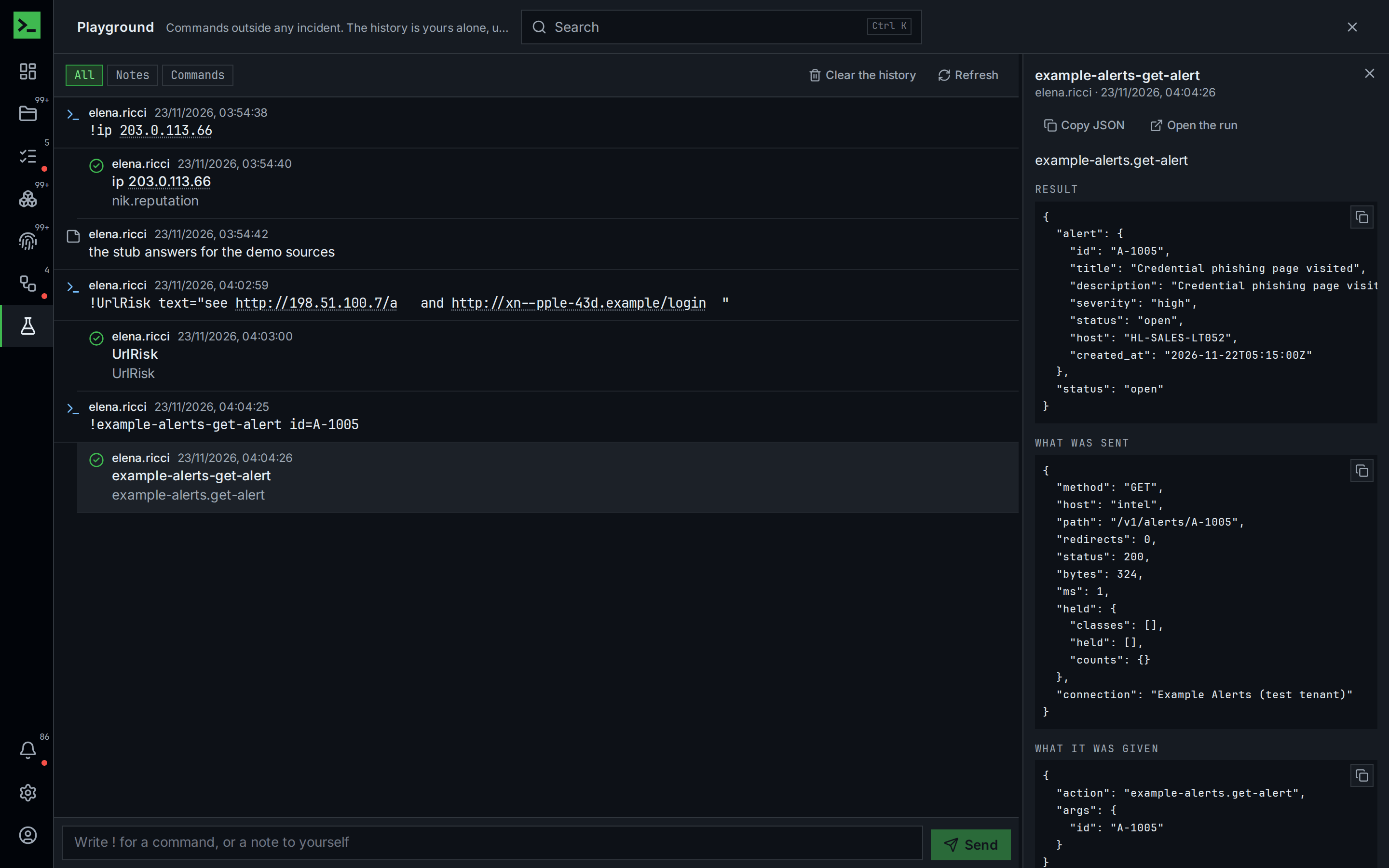
- Open the connector's commands and press Try it beside
get-alert. The Playground opens with!example-alerts-get-alert id=ready. - Give an id and press Enter. Open the result: what was sent, what came back, the outputs.
- For a command marked changes, Nik asks you to confirm the line first. Try it on something harmless.
| What you see | Look at |
|---|---|
example-alerts answered 404: … |
The path, or the id given |
answered 401 |
The token of the instance |
| An output empty | Its template: an answer without that key gives an empty output, not an error |
| A request to another host refused | A full address in path must be on the instance's host, or in more_hosts |
On the canvas, the commands are in Commands › Example Alerts, each with an Instance field. In a dry run nothing is sent: the step shows the request that would have left and gives sample.
12. Fetch and map
- Open the instance, tab Fetch. Turn on Fetch incidents, keep How often and First fetch, Save.
- Under How it goes, press Fetch now, then What it fetched…: each alert and what became of it.
- Tab Mappers, direction Incoming, Every type. Fill the rows: name
{{ item.title }}, details{{ item.description }}, severity{{ item.severity }}, host{{ item.host }}, source_id{{ item.id }}. Add a context path:Alert(val.ID == obj.ID)with{"ID": "{{ item.id }}", "Name": "{{ item.title }}", "Source": "Example Alerts"}. - Use the last item it fetched, then Try on the sample: each row shows the value the incident would get.
- Direction Outgoing: title
{{ incident.name }}, status{{ incident.status }}. Save.
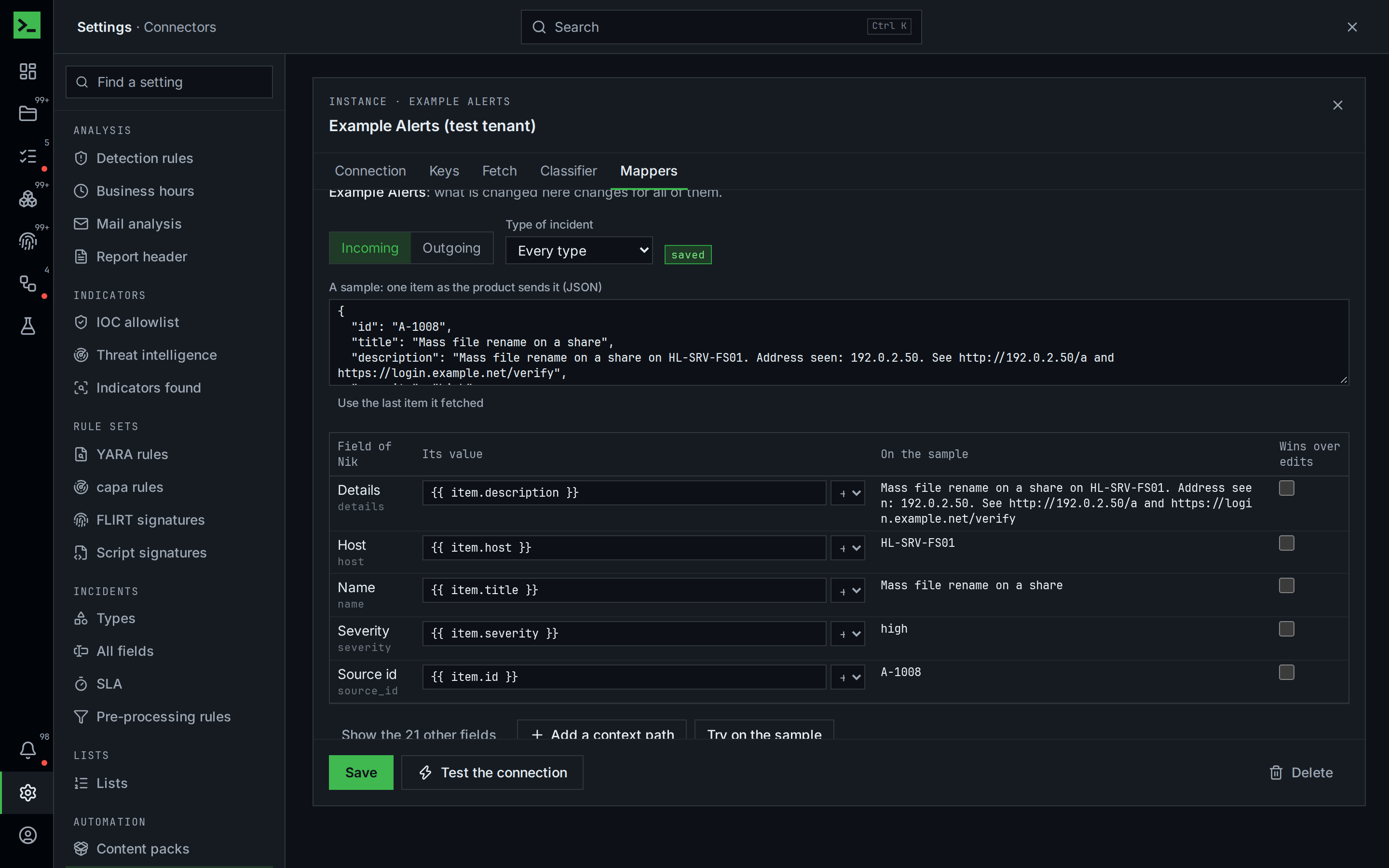
An item the mapper cannot make whole still becomes an incident, listed as incomplete in What it fetched… with what was wrong.
13. Turn mirroring on
- Tab Fetch, part Mirroring: choose In-out. Each choice says what it does with this connector.
- Save. Incidents fetched from now on are mirrored. Apply mirroring to open incidents… does it for those already there.
- On an incident, write a note tagged
mirror: it is sent withadd-comment. Change the alert's status on the product: Read now in the incident's Mirror panel shows it.
See Mirroring.
14. Contribute it to Nik's repository
A connector in Nik's repository lives in a pack, packs/<id>/connectors/<id>/connector.yml, with a logo.png and a README.md that says what it was written against (A content pack). It is tested without the real product, against recorded exchanges: one file per command in backend/tests/data/connectors/<id>/.
connection.json: the configuration and invented credentials the recordings use.
get-alert.json: the arguments, every request the command must send, the answers the product's documentation shows, and the outputs Nik must give.
{
  "args": { "id": "A-1005" },
  "exchanges": [
    {
      "request": {
        "method": "GET",
        "path": "/v1/alerts/A-1005",
        "headers": { "Authorization": "Bearer ea-token-0123456789" }
      },
      "response": {
        "status": 200,
        "json": { "id": "A-1005", "title": "Credential phishing page visited", "severity": "high", "status": "open" }
      }
    }
  ],
  "outputs": {
    "alert": { "id": "A-1005", "title": "Credential phishing page visited", "severity": "high", "status": "open" },
    "status": "open"
  }
}
- Every command needs one;
fetch.jsonrecords the fetch (withsince), andmirror.jsoneach call of the mirror (mirror.get, …). Copy the shape from an existing connector ofbackend/tests/data/connectors/. backend/tests/test_shipped_connectors.pyruns them, with the other backend tests (Developer guide).- Keep
verified: falseuntil someone has run every command against a real system.
The complete file
example-alerts.yml
# Example Alerts: alerts of an imaginary product, through its REST API at api.example.com.
# Signs in with a bearer token. Brings alerts in as incidents and keeps them in step both ways.
name: Example Alerts
id: example-alerts
version: 1
description: Alerts of Example Alerts as incidents, kept in step both ways; an IP reputation look-up.
api_version: "Example Alerts API v1"
verified: false

configuration:
  - name: url
    label: Address
    type: url
    required: true
    default: https://api.example.com
    help: "The address of the API, https://api.example.com"
  - name: credentials
    type: bearer

base_url: "{{ config.url }}/v1"
headers:
  Accept: application/json

test:
  request: { method: GET, path: /me }
  expect: { status: 200 }

commands:
  - name: get-alert
    description: Read an alert by its id.
    arguments:
      - { name: id, type: text, required: true, description: "The id of the alert: A-1005" }
    request: { method: GET, path: "/alerts/{{ args.id | urlencode }}" }
    error: { message: "{{ response.error.message }}" }
    outputs:
      alert: "{{ response }}"
      status: "{{ response.status }}"
    context:
      - path: Alert(val.ID == obj.ID)
        value: { ID: "{{ response.id }}", Name: "{{ response.title }}", Severity: "{{ response.severity }}", Source: Example Alerts }
    sample:
      alert: { id: A-1005, title: Credential phishing page visited, severity: high, status: open }
      status: open

  - name: list-alerts
    description: The alerts created since a moment, read page by page.
    arguments:
      - { name: since, type: text, description: "An ISO date; empty for every alert" }
      - { name: limit, type: number, default: 200, description: How many at most }
    request:
      method: GET
      path: /alerts
      query: { created_after: "{{ args.since }}" }
    pagination:
      type: cursor
      items: "{{ response.data }}"
      param: cursor
      next: "{{ response.next_cursor }}"
      limit_param: page_size
      limit: 100
      max_pages: 10
    outputs:
      alerts: "{{ response.items }}"
      count: "{{ response.items | length }}"
      truncated: "{{ response.truncated }}"

  - name: set-status
    description: Set the status of an alert. Setting it twice leaves it as once.
    changes_outside: true
    arguments:
      - { name: id, type: text, required: true }
      - { name: status, type: choice, choices: [open, in_progress, closed], required: true }
    request:
      method: PATCH
      path: "/alerts/{{ args.id | urlencode }}"
      json: { status: "{{ args.status }}" }
    error: { message: "{{ response.error.message }}" }
    outputs:
      status: "{{ response.status }}"
    sample: { status: closed }

  - name: update-alert
    description: Change the fields of an alert (what the outgoing mapper gives).
    changes_outside: true
    arguments:
      - { name: id, type: text, required: true }
      - { name: fields, type: object, required: true }
    request:
      method: PATCH
      path: "/alerts/{{ args.id | urlencode }}"
      json: "{{ args.fields }}"
    error: { message: "{{ response.error.message }}" }
    outputs:
      status: "{{ response.status }}"
    sample: { status: open }

  - name: get-comments
    description: The comments of an alert, oldest first.
    arguments:
      - { name: id, type: text, required: true }
    request: { method: GET, path: "/alerts/{{ args.id | urlencode }}/comments" }
    outputs:
      comments: "{{ response.data }}"
    sample:
      comments: [{ id: c-1, body: Seen on two hosts., author: ana, created_at: "2026-11-20T08:00:00Z" }]

  - name: add-comment
    description: Add a comment to an alert. Twice is two comments.
    changes_outside: true
    idempotent: false
    arguments:
      - { name: id, type: text, required: true }
      - { name: text, type: text, required: true }
    request:
      method: POST
      path: "/alerts/{{ args.id | urlencode }}/comments"
      json: { body: "{{ args.text }}" }
    success: { status: [200, 201] }
    outputs:
      comment: "{{ response.id }}"
    sample: { comment: c-2 }

  - name: open-case
    description: Open a case for an alert. The API acts once per Idempotency-Key.
    changes_outside: true
    idempotency_key: true
    arguments:
      - { name: alert, type: text, required: true }
      - { name: title, type: text, required: true }
    request:
      method: POST
      path: /cases
      headers: { Idempotency-Key: "{{ idempotency.key }}" }
      json: { alert_id: "{{ args.alert }}", title: "{{ args.title }}" }
    success: { status: 201 }
    error: { message: "{{ response.error.message }}" }
    outputs:
      case: "{{ response.id }}"
      url: "{{ response.url }}"
    sample: { case: K-1, url: "https://app.example.com/cases/K-1" }

  - name: ip-reputation
    description: What Example Alerts knows of an IP address.
    reputation: ip
    arguments:
      - { name: ip, type: text, required: true }
    request: { method: GET, path: "/reputation/ip/{{ args.ip | urlencode }}" }
    outputs:
      verdict: "{{ response.verdict | map(bad='malicious', risky='suspicious', good='harmless', else='unknown') }}"
      summary: "{{ response.reports | plural('report') }} in 90 days"
      link: "https://app.example.com/ip/{{ args.ip | urlencode }}"
      reports: "{{ response.reports }}"
    sample: { verdict: unknown, summary: "0 reports in 90 days", link: "https://app.example.com/ip/192.0.2.1", reports: 0 }

fetch:
  interval_seconds: 120
  first_fetch: 3 days
  lookback_minutes: 5
  request:
    method: GET
    path: /alerts
    query:
      created_after: "{{ since.iso }}"
      order: created_at
  error: { message: "{{ response.error.message }}" }
  pagination:
    type: cursor
    items: "{{ response.data }}"
    param: cursor
    next: "{{ response.next_cursor }}"
    limit_param: page_size
    limit: 100
    max_pages: 2
  item_id: "{{ item.id }}"
  occurred: "{{ item.created_at }}"

mirror:
  interval_seconds: 120
  get: { command: get-alert }
  item: "{{ result.alert }}"
  update:
    command: update-alert
    args: { id: "{{ mirror.id }}", fields: "{{ fields }}" }
  comments:
    list: { command: get-comments }
    items: "{{ result.comments }}"
    id: "{{ item.id }}"
    text: "{{ item.body }}"
    author: "{{ item.author }}"
    at: "{{ item.created_at }}"
    add:
      command: add-comment
      args: { id: "{{ mirror.id }}", text: "{{ comment.text }}" }

schema:
  incoming:
    - { name: id, type: text, description: "The id of the alert: A-1005" }
    - { name: title, type: text }
    - { name: description, type: text }
    - { name: severity, type: text, description: "low, medium, high or critical" }
    - { name: status, type: text, description: "open, in_progress or closed" }
    - { name: host, type: text }
    - { name: created_at, type: date }
  outgoing:
    - { name: title, type: text }
    - { name: status, type: text }